Best Proxies for Target Pokémon Card Restocks (2026)
The Short Answer
For Target Pokémon card restocks, limited collectibles, and high-demand retail releases, start with static ISP proxies or sticky residential sessions. Target shopping is location-aware: the selected store, ZIP code, account, inventory view, and fulfillment method all shape the session. A stable residential route fits that flow better than constantly changing IPs.
Use one proxy per legitimate account or active checkout session. Keep the same session through sign-in, cart, pickup or shipping selection, and payment. Proxies are network tools, not permission to automate Target or bypass its controls, so follow Target's terms and any product limits.
Target Proxy Setup at a Glance
| Target Workflow | Best Starting Type | Session Rule | Priority |
|---|---|---|---|
| Pokémon card checkout | Static ISP or sticky residential | One stable session per account | Trust and continuity |
| Order Pickup | Static ISP or sticky residential | Match account, store, and region | Location consistency |
| Shipped preorder | Static ISP or sticky residential | Hold the route through payment | Account stability |
| Light availability checks | Datacenter or residential | Low frequency, authorized use only | Clean connectivity |
| Backup checkout session | ISP or residential | Test once, then keep quiet | Readiness |
If you want one pool that can cover account login and checkout, ISP proxies are the strongest all-around starting point. They use residential ISP networks while giving you a static IP that is easier to keep assigned to one session.
Why Target Restocks Need a Different Proxy Plan
Target is not one generic product-page workflow. A customer may be checking nearby stock, choosing Order Pickup, selecting shipping, or waiting for a preorder window. Target's own help pages explain that store availability depends on the selected location and that pickup is tied to an eligible local store.
That creates three practical requirements:
- Location coherence. The selected store or shipping region should make sense next to the proxy location and account profile.
- Session continuity. A checkout should not jump between unrelated networks after an item reaches cart.
- Task discipline. Extra refreshes and extra sessions do not create more inventory; they create more opportunities for errors.
For a Pokémon Trading Card Game launch, your cleanest setup is usually a small number of prepared sessions, not a huge pool rotating on every request.
Static ISP vs Residential vs Datacenter for Target
Static ISP Proxies
Static ISP proxies are the best default for a serious Target buying session. They pair a residential network identity with a stable address, so the same Target account can stay on one route from login through checkout.
Use them when:
- You are signed into a Target account
- You are selecting a local store or pickup location
- You need a session to survive cart and payment
- You want predictable per-IP assignment
Sticky Residential Proxies
Sticky residential sessions are a strong alternative when ISP inventory is unavailable or when you need more regional choice. Confirm how long the session stays attached to one IP. A "sticky" session that expires during a queue or checkout is not actually useful for that workflow.
Datacenter Proxies
Datacenter proxies can be fast and cost-effective for light, permitted availability checks, but they are not our first choice for account-heavy Target checkout. If you use them, keep monitoring separate from checkout and test the exact Target route lightly before a release.
For the broader tradeoffs, read our residential vs ISP vs datacenter proxy comparison.
Target Pokémon Card Restock Setup
Pokémon card releases bring together local availability, online inventory, and buyer demand. Prepare the session before the product goes live:
- Choose the Target account and fulfillment path you will actually use.
- Select the correct store or confirm the shipping ZIP code.
- Assign one tested ISP or sticky residential proxy to that session.
- Confirm basic connectivity and region, then stop unnecessary testing.
- Keep that route stable through cart, fulfillment selection, and payment.
Do not treat a proxy as a way around item limits or account rules. A strong connection cannot fix mismatched billing data, unavailable local inventory, an ineligible pickup item, or a declined payment.
Order Pickup vs Shipping
Target publishes separate guidance for store availability, Order Pickup, and preorders. Your proxy plan should follow the fulfillment path.
Order Pickup: prioritize regional consistency. The proxy does not need to appear inside the store, but it should not conflict dramatically with the account, selected store, and normal customer location.
Shipping: prioritize account and payment continuity. Keep one route through address confirmation and authorization instead of rotating after add-to-cart.
Preorders: prioritize durability. A clean checkout is only the first step; product availability, authorization holds, and Target's order handling still apply.
How Many Target Proxies Do You Need?
Plan around one proxy per legitimate account or simultaneous checkout session, then add modest backup capacity.
| Active Sessions | Starting Proxies | With 10-20% Spares |
|---|---|---|
| 5 | 5 | 6 |
| 10 | 10 | 11-12 |
| 20 | 20 | 22-24 |
| 50 | 50 | 55-60 |
Backups are replacements for routes that fail format, authentication, connectivity, or region checks. They are not a reason to multiply orders or ignore retailer limits.
Use our proxy sizing guide if you are planning across Target, Walmart, Pokémon Center, Shopify, and sneaker releases.
Pre-Restock Target Checklist
- Target account, payment, and address are current
- Selected store or shipping ZIP is correct
- One ISP or sticky residential proxy is assigned per active session
- Proxy region is coherent with the buying profile
- Format and authentication have been checked
- One light connectivity check has passed
- Pickup and shipping sessions are clearly separated
- Spare sessions are ready but idle
- Product limits and Target's terms have been reviewed
The Zenu Proxy Tester can validate format, connection, region, latency, and a light target response from the same computer that will run the session. Test for readiness, not volume.
Common Target Proxy Mistakes
Rotating during checkout. Keep one IP through sign-in, cart, fulfillment selection, and payment.
Ignoring the selected store. Target inventory is store-aware. A mismatched store, ZIP, and route creates confusion even before payment.
Using checkout proxies for constant monitoring. Keep the cleanest sessions quiet until they matter.
Buying only for raw speed. Target checkout benefits from a route that is stable and coherent, not merely the lowest latency number.
Expecting proxies to override inventory or limits. They cannot. Proxies improve connection management; Target controls availability and orders.
Build a Cleaner Target Restock Setup
For Target Pokémon cards and collectible restocks, the winning network plan is straightforward: static ISP or sticky residential sessions, one clean route per active checkout, region-aware store selection, and enough spares to replace failed connections without scrambling.
Zenu offers ISP and residential options built for stable retail sessions, plus a local tester to clean the list before release time. Compare Zenu proxy plans and size the package around the sessions you will actually run.
Target Proxy FAQs
What proxies are best for Target restocks?
Static ISP or sticky residential proxies are the strongest starting point for legitimate Target account, pickup, and checkout sessions because they combine residential routing with session stability.
How many proxies do I need for Target?
Start with one stable proxy per legitimate account or active checkout session, then keep 10-20% spare capacity for failed connectivity checks.
Should my Target proxy match my pickup store?
Keep the proxy region, Target account, selected store or ZIP code, and fulfillment choice geographically consistent whenever possible.
Can proxies guarantee a Target Pokémon card checkout?
No. Proxies can improve connection separation and consistency, but inventory, product limits, account standing, payment approval, and Target's rules still determine whether an order succeeds.
Related guides:
Related Posts
Best Proxies for Walmart Pokémon Card Restocks (2026)
Choose proxies for Walmart Pokémon card restocks, shipping, pickup, and delivery while keeping accounts, stores, and checkout sessions consistent.
Best Proxies for Pokémon Center Drops in 2026
Choose proxies for Pokémon Center drops with sticky-session setup, practical package sizing, queue guidance, and a transparent pre-restock test method.
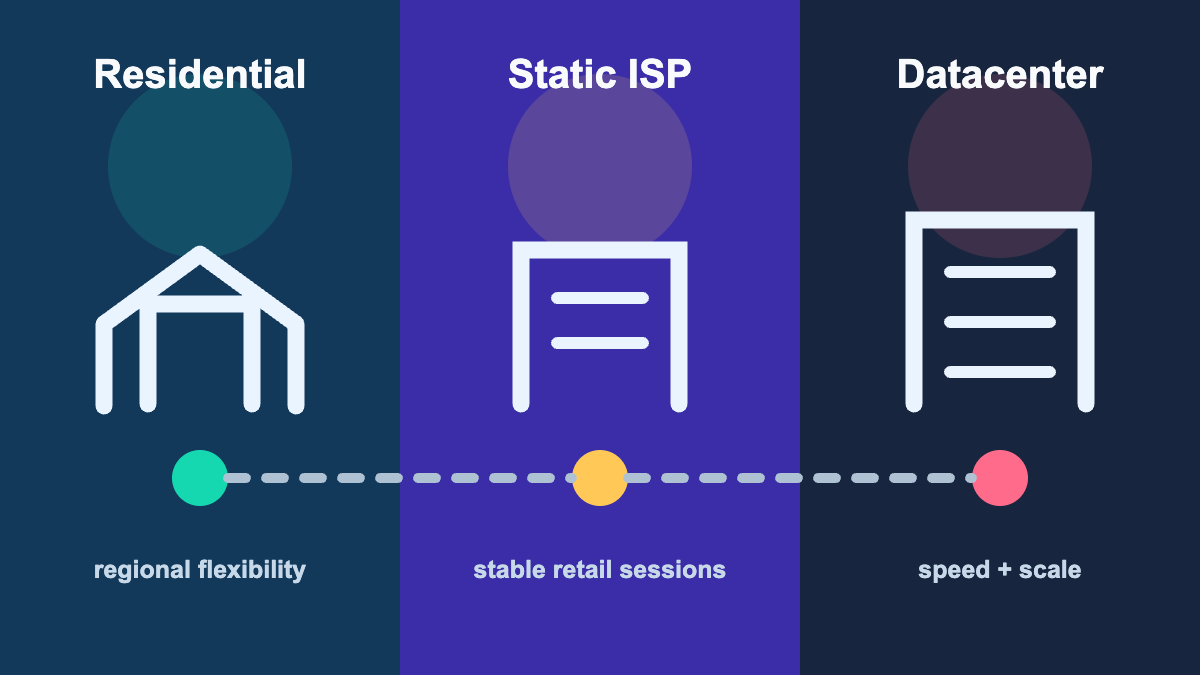
Residential vs ISP vs Datacenter Proxies (2026 Guide)
Compare residential, static ISP, and datacenter proxies by speed, session stability, cost, and fit for Target, Walmart, Shopify, SNKRS, and Pokemon Center.